
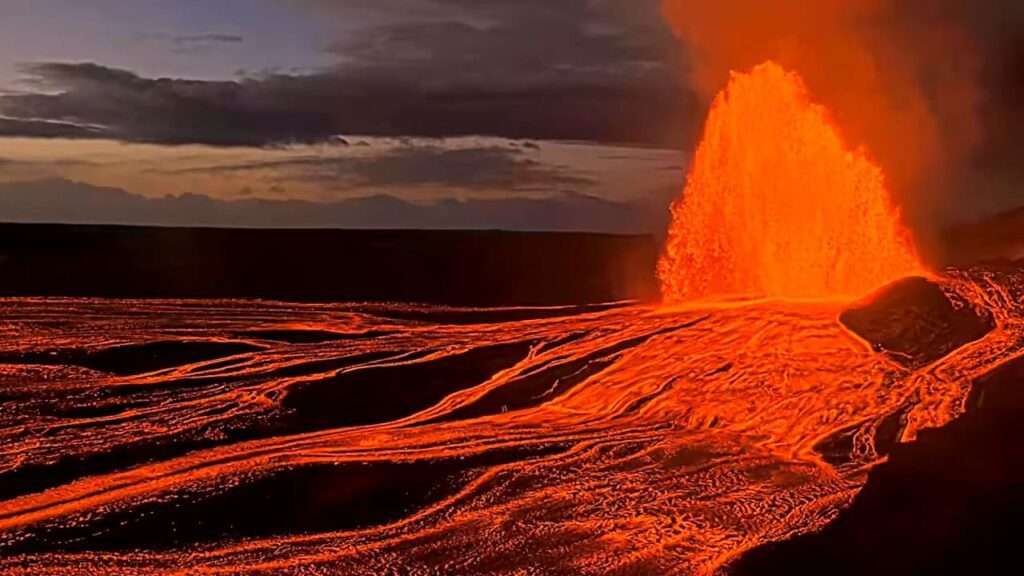
Kīlauea is erupting right now. As of mid-November 2026, the USGS Hawaiian Volcano Observatory is forecasting episode 57 between November 18 and 22 — meaning lava fountains could be shooting hundreds of feet into the air from Halemaʻumaʻu crater during your visit. This is not a theoretical experience. If you are staying at Aloha Hale Volcano Hawaii, the park entrance is about five minutes from your front door.
This guide covers everything you need to know to plan your visit: what is currently happening at the summit, the best overlooks to watch from, what to bring, when to go, and how to stay safe.
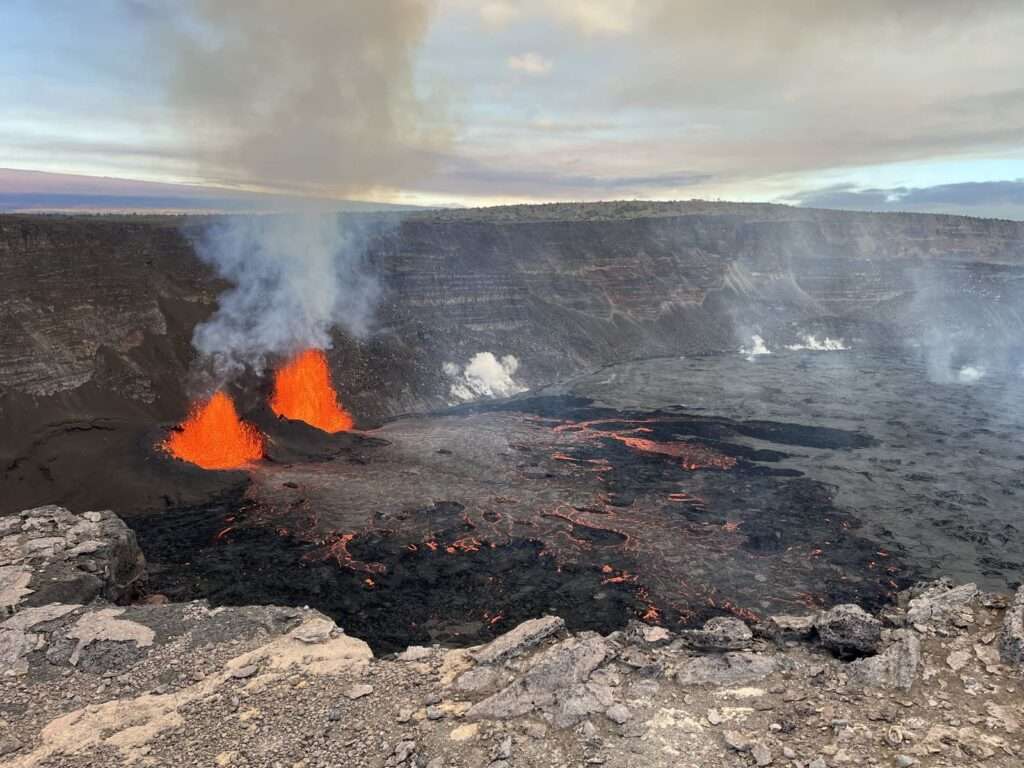
What Is Happening at Kīlauea Right Now
The current eruption at Kīlauea’s summit began on December 23, 2024, and has been running in episodic bursts ever since — making it the longest-running episodic fountaining eruption on record. By November 2026, the eruption has completed 56 episodes. Each episode typically lasts several hours and produces lava fountains inside Halemaʻumaʻu crater, with plumes rising thousands of feet above the park.
Episode 56 erupted on November 5, 2026, from 12:10 p.m. to 6:01 p.m. HST. The north vent fountains reached approximately 660 feet, and the eruption plume climbed to around 18,000 feet above sea level before drifting northwest toward Mauna Loa’s summit. Fine volcanic ash and Pele’s hair — delicate strands of volcanic glass — fell along Highway 11 west of the summit.
As of November 15, the USGS tiltmeter at Uēkahuna had recovered about 13 microradians of inflationary tilt since episode 56 ended. Sulfur dioxide emissions measured around 2,000 tonnes per day — a sign the magma reservoir is actively recharging. Moderate to strong glow was visible from the north and southwest vents at night, with rare spatter and flames at the southwest vent.
The park’s alert level is currently ADVISORY with an YELLOW aviation color code. When episode 57 begins, the alert will be raised to WATCH and the aviation code to ORANGE. Check the USGS Hawaiian Volcano Observatory (hvo.wr.usgs.gov) the morning of your visit for the most current status. Conditions can change within hours.
The Six Overlooks: Where to Watch From

The eruption itself is entirely inside Halemaʻumaʻu crater, which is closed to the public. All viewing happens from the crater rim. The park has six main overlook areas along Crater Rim Drive, each with a different vantage point and parking situation.
1. Uēkahuna Overlook
This is the largest parking area on Crater Rim Drive West and typically the last to fill during active eruption nights. Rangers are often stationed here. The overlook faces the caldera directly and offers one of the most open views of Halemaʻumaʻu. If you arrive late and other lots are full, start here.
2. Kīlauea Overlook at Kūkamāhuākea
Located about 2.5 miles from the park entrance, or a 0.4-mile walk from Uēkahuna on the Crater Rim Trail. During active episodes, lava fountains are clearly visible from here at dusk and after dark. This is one of the most popular spots, so the lot fills quickly — sometimes by 10 a.m. on eruption days.
3. Wahinekapu (Steaming Bluff)
About one mile from the park entrance. Even between eruption episodes, the steam vents here are active and visually dramatic — heated groundwater meets cool air and billows upward along the crater rim. This spot is worth visiting at any time, not just during active lava episodes.
4. Kūpinaʻi Pali (Waldron Ledge)
A 0.5-mile walk from the closed visitor center. The trail here follows the original Crater Rim Drive along the caldera edge, offering a quieter alternative to the main overlooks when parking lots are full. The perspective looking across to Halemaʻumaʻu is striking even without active lava.
5. Keanakākoʻi Overlooks
A two-mile round trip from the Devastation Trailhead. These overlooks on Crater Rim Drive East offer a different angle on the caldera and are generally less crowded than the western overlooks. The trailhead itself has extremely limited parking during eruptions, so arrive well before dark or use the Puʻuʻōʻō Overlook overflow lot and add half a mile each way.
6. Near the Welcome Center
The shortest walk from any parking area to a crater view. The temporary Welcome Center is open 9 a.m. to 4:45 p.m. daily — stop here first for eruption status, ranger briefings, and current road conditions before heading to your chosen overlook.
When to Go: Timing Your Visit
The calculus changes depending on whether an eruption episode is active or the summit is in a recharge pause.
During an active episode: Arrive in the afternoon, explore the trails and other areas in daylight, and position yourself at an overlook as the sun sets. The glow intensifies dramatically after dark. The lava fountains and crater glow are visible from the rim even during daytime episodes, but the visual impact at night is incomparable. Lots near the summit fill by 10 a.m. on eruption days, so an early afternoon arrival gives you the best chance of a close parking spot.
Between episodes: Even when lava is not actively fountaining, Halemaʻumaʻu often glows at night from residual heat in the crater. The steam vents, sulphur banks, and caldera views remain impressive. This is also the best time to hike — trails are less crowded and parking is straightforward.
Weekdays vs. weekends: Weekday mornings, ideally before 9 a.m., see significantly smaller crowds. Weekend afternoons during active episodes are the busiest periods, with overflow parking and long walks from distant lots.

The Trails Worth Doing
Hawaii Volcanoes National Park has more than 100 miles of trail. These are the ones most worth your time given the current eruption activity.
Kīlauea Iki Loop (3.3 miles, 2–3 hours)
This is the park’s signature hike. The trail descends 400 feet into a former lava lake that last erupted in 1959, crosses the hardened but still-steaming lava floor, and climbs back through a rainforest section. The contrast — open black lava, steam rising from cracks, dense ‘ōhiʻa forest overhead — is unlike anything else on the island.
The Kīlauea Iki Overlook lot is very limited. The park recommends starting from the Devastation Trailhead (6 miles round-trip, 4–5 hours) or the Welcome Center area (5.3 miles round-trip, 3–4 hours) to access the full loop.
Thurston Lava Tube / Nāhuku (1.5 miles round-trip)
A 500-year-old lava tube you walk through — 10 feet wide and 15 feet high in places, formed when the outer crust of a lava flow hardened while the molten interior drained away. The tube section is lit from 8 a.m. to 8 p.m. Outside those hours, bring a headlamp. The trail was one-way during a bridge replacement in mid-2026; check current status at the Welcome Center.
Haʻakulamanu / Sulphur Banks (1.2 miles round-trip)
A short loop past bright yellow and orange sulphur deposits, with steam rising from vents in the ground. The smell of volcanic gas is noticeable. This trail is not recommended for people with asthma, heart conditions, or respiratory issues, or for young children and pregnant visitors. For everyone else, it is a vivid close-up look at active volcanic geology.
Chain of Craters Road (18.8 miles to the coast)
The road descends 3,700 feet from the summit to the Pacific Ocean, passing ancient lava flows, pit craters, and petroglyphs along the way. There is no food, water, or fuel on the road or at its end — fill your tank and water bottles at the summit before you descend. Vault toilets are at the Maunaulu parking area and the road’s end. The Hōlei Sea Arch, a dramatic natural arch carved by the ocean at the road’s end, partially collapsed in late September 2026; the viewpoint remained open but check current status.

What to Bring
The summit of Kīlauea sits at around 4,000 feet elevation. Even if you drove up from a sunny Kona afternoon, expect cooler temperatures, wind, and the possibility of rain at the top. Pack layers — a light jacket or fleece at minimum.
For an eruption night visit specifically:
- Headlamp — the overlook paths are unlit and uneven after dark
- Eye protection — volcanic tephra including Pele’s hair can drift toward the viewing areas during active episodes; sunglasses or safety glasses offer protection
- Long sleeves and pants — both for volcanic debris and for the cooler summit temperatures after sunset
- Water and snacks — no food vendors are at the overlooks; Volcano House near the caldera rim has a limited menu but waits can be long on eruption nights
- Fully charged phone — for USGS alerts, NPS updates, and navigation back in the dark
- Cash or card for entry — $30 per vehicle, valid for seven days. The America the Beautiful Annual Pass ($80) covers entry and is worth it if you plan to visit more than twice or visit other national parks this trip
Air Quality and Vog: What to Know
Volcanic smog — called vog — forms when sulfur dioxide from the eruption mixes with sunlight, oxygen, and moisture in the air. With sulfur dioxide emissions currently running around 2,000 tonnes per day, vog is an active consideration for visitors and for people staying in the area.
Vog typically affects the Kona coast when trade winds are weak and winds shift south or southwest. At the summit, gas concentrations are highest during and immediately after active eruption episodes. The NPS posts real-time air quality readings on the HAVO website and at the Welcome Center.
If you have asthma, heart disease, or any respiratory condition — or if you are traveling with young children or during pregnancy — check air quality at the park’s monitor before heading out. During high-gas periods, the park may close specific areas. Everyone should avoid handling Pele’s hair or other tephra found near the summit after an eruption episode.
For residents and guests staying nearby: after tephra falls, check and flush rain catchment systems. Slow down on Highway 11 during reduced visibility from vog or ash. The USGS Volcano Notification Service sends free email and text alerts when activity changes — sign up at vns.usgs.gov.
Practical Details: Fees, Hours, and Logistics
Entry fees: $30 per private vehicle, $25 per motorcycle, $15 per pedestrian or cyclist. The pass is valid for seven days. The Hawaiʻi Tri-Park Pass costs $55 and covers this park, Puʻuhonua o Hōnaunau (Place of Refuge), and Haleakalā on Maui.
Hours: The park is open 24 hours, 365 days a year. The temporary Welcome Center is open 9 a.m. to 4:45 p.m. daily. The main Kīlauea Visitor Center is closed for renovation through late 2026.
Camping: Nāmakanipaio tent sites are $15 per night, first-come, first-served. Kulanaokuaiki sites are $10 per night. Both are limited to seven nights total.
From Aloha Hale: The park entrance is about five minutes south on Highway 11. The Welcome Center and the main overlooks are within 10 minutes of the gate. You can leave in the late afternoon, watch the eruption glow through the evening, and be back at the property in time for a late dinner — without any long drive.
Nēnē geese: Hawaii’s state bird lives in the park and is endangered. They walk across roads and parking lots without concern for traffic — slow down and do not feed them.
The Bottom Line
An episodic eruption at Kīlauea’s summit is not something you can reliably schedule around — but right now, in late November 2026, the USGS is forecasting active lava fountaining within days. If you are staying in Volcano Village, you are as close to this as any visitor can be without a helicopter. Five minutes to the gate, ten minutes to the rim, and you are watching one of the most active volcanoes on Earth erupt in real time.
Check the USGS Hawaiian Volcano Observatory update each morning at hvo.wr.usgs.gov. When the alert level goes to WATCH, head to the park.